Sunday, February 26, 2012

OSCAR PICKS: It's A Parisian Invasion!

Happy Oscar day world! Reminding all my of east-of-Sepulveda friends not to venture north of Melrose between La Cienga and Vine, unless you're prone to masochism. Today in Hollywood we celebrate...the French? Between Woody Allen's mystical Parisian escapade, Scorsese's love letter to George Méliès, and the cast and crew of The Artist, it's time put away the Freedom Fries and break out a beret, a baguette and your fruitiest Bordeaux. Off we go... 


Best Actress in a Leading Role

Glenn Close, Albert Nobbs
Viola Davis, The Help
Rooney Mara, The Girl With the Dragon Tattoo
Meryl Streep, The Iron Lady
Michelle Williams, My Week With Marilyn

Who will win: VIOLA DAVIS 
Superb actor, wish she didn't have to get her statue playing a maid. 

Who should win: GLENN CLOSE 
Meryl's performance as Maggie Thatcher was flawless but I rather spread the wealth. Close deserves this as much as anyone.


Best Actor in a Leading Role

Demian Bichir, A Better Life
George Clooney, The Descendants
Jean Dujardin, The Artist
Gary Oldman, Tinker Tailor Soldier Spy
Brad Pitt, Moneyball

Who Will Win: JEAN DUJARDIN
In arguably the tightest race, I'm gonna go Jean over George and Brad. All these movies were charmingly solid, and the leading men did the heavy lifting. It's a jump ball, but this feels like the year of The Artist.

Who Should Win: DEMIAN BICHIR
Like Leo DiCaprio, Pitt has amassed an impressive breadth of work and has never won an Oscar, but I'm going to go with Bichir. I realize the nomination was his "award' but this was a brilliantly understated performance in a movie that's as much of an LA story as LA Story.


Best Writing (Original Screenplay)

The Artist
Bridesmaids
Margin Call
Midnight in Paris
A Separation

Who will win: THE ARTIST
Bridesmaids or Midnight in Paris could pull off an upset, but I won't bet against the tide. 

Who should win: MARGIN CALL
Not only was the script watertight, it was devastatingly relevant social and economic commentary. 


Best Writing (Adapted Screenplay)

The Descendants
Hugo
The Ides of March
Moneyball
Tinker Tailor Soldier Spy

Who will win: THE DESCENDANTS
Thanks for playing, here's your consolation prize.  

Who should win: TINKER TAILOR SOLDIER SPY
A confounding and beguiling film driven by a beautiful and intricate screenplay.


Best Actress in a Supporting Role

Berenice Bejo, The Artist
Jessica Chastain, The Help
Melissa McCarthy, Bridesmaids
Janet McTeer, Albert Nobbs
Octavia Spencer, The Help

Who will win: OCTAVIA SPENCER
A break out role for sure; hopefully this will secure more and more...

Who should win: MELISSA MCCARTHY
Hey, I'm a sucker for Chris Farley humor.


Best Actor in a Supporting Role

Kenneth Branagh, My Week With Marilyn
Jonah Hill, Moneyball
Nick Nolte, Warrior
Christopher Plummer, Beginners
Max von Sydow, Extremely Loud & Incredibly Close

Who will win: CHRISTOPHER PLUMMER
This will be well-deserved. No qualms. 

Who should win: NICK NOLTE 
A sentimental choice. He was fantastic in Warrior but his acceptance speech has the chance of becoming even more memorable.  


Directing

Michel Hazanavicius, The Artist
Alexander Payne, The Descendants
Martin Scorsese, Hugo
Woody Allen, Midnight in Paris
Terrence Malick, The Tree of Life

Who will win: MICHEL HAZANAVICIUS 
Year of The Artist. 

Who should win: MICHEL HAZANAVICIUS
*but really Nicolas Winding-Refn for Drive.
Sorry, I had to.


Best Picture

The Help
The Descendants
The Artist
Moneyball
Hugo
Midnight in Paris
The Tree of Life
War Horse
Extremely Loud and Incredibly Close

Who will win: THE ARTIST
Last year, I claimed I'd be "shocked" if The Artist didn't win Best Picture. In Hollywood, the Academy Awards are an annual celebration of Hollywood. So, when a black and white movie backed by Harvey Weinstein celebrates the history and majesty of cinema, that's as close to a shoe-in as we can get. 

Who should win:  THE ARTIST
As far as celluloid love letters to Tinseltown go, I slightly prefer Hugo but will cede  
The Artist may be more timeless. Let's see if in ten years, the silent homage holds up as the definitive film of 2011. My guess is that it will.

But, if I were voting, the nominees would be:
Drive
Margin Call
50/50
Young Adult
A Better Life
Pariah

So what do I know?

Au revoire!


@HebrewRational


Friday, February 24, 2012

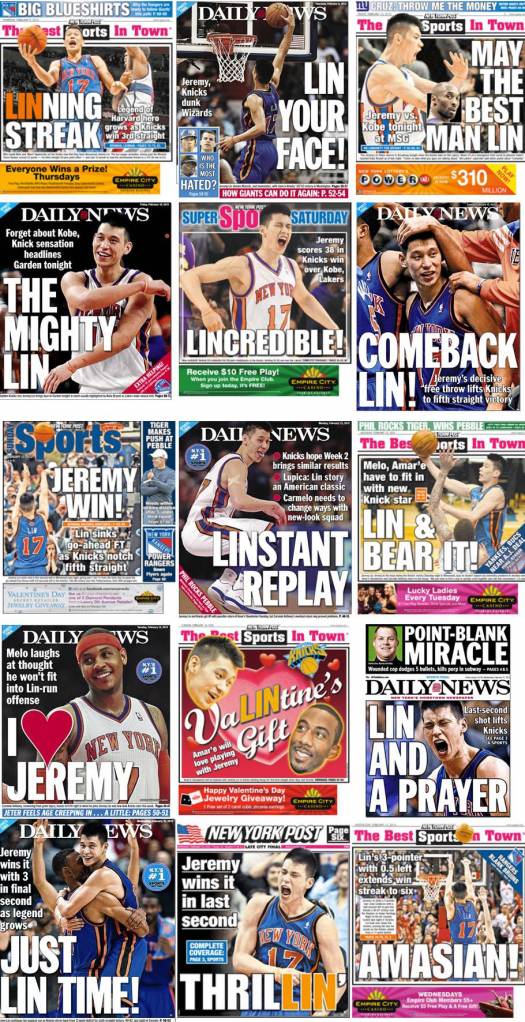
THE LIN AND TEBOW EFFECT

Now that Jeremy Lin has graced the cover of TIME magazine, it would appear that this remarkable story is about ready to jump the shark. While the subject of Lin's ethnicity is impossible to ignore and has unquestionably enhanced the spectacle, adding a variety of dimensions and controversies, it is not something I seek to belabor. As Linsanity winds its way through the culture and presumably loses momentum, I am hopeful it will leave us with an overdue discussion ---not about race--- but about talent evaluation.

Recently, a college basketball scout was interviewed on a sports radio show and he tried to explain why Lin's ability was never properly identified. He offered the standard responses about his size and strength, the release of his jumpshot, how he was shooting guard at Harvard who averaged less than 13 points a game, etcetera; but his primary purpose was to assure everyone that although recruiting is an imperfect science, it remains "colorblind" and "transparent." Nonsense...

First, the term "colorblind" is one of the more insidious expressions of political correctness. No one is colorblind. It is ludicrous to even suggest that we can instinctively disassociate the context of someones appearance, whether in judgement, prejudgement or simple observation. Even by its literal definition, colorblindness refers to the lack of an accepted perspective. (My blue may be your purple so whose blue is blue?) Stephen Colbert will occasionally mock this absurdity when he reminds his audience that he "doesn't see gender." Professional scouts are even less "colorblind." The most common practice in talent evaluation is drawing athletic comparisons between similar athletes, which is almost never done across racial lines. Although I am not suggesting scouts use a conscious bias, I will argue that someone like Jeremy Lin alluded comparisons, and thus attention, not because of his game, but because of his physiognomy. Without another Asian point guard to compare him to, he went largely unrecruited by Division 1 schools, despite leading a very visible program in Palo Alto, CA to a state championship.


Close your eyes and imagine Yao Ming as a 6'6" all-star point guard, instead of a 7'6" evolutionary anomaly, imported from a nation of one billion. Would this have changed the perception of Lin's game? With an obvious visual analogy, perhaps Lin is heavily recruited out of high school; maybe he chooses Duke, leaves after his junior year and becomes a lottery pick because a dozen teams are fighting over the chance to draft the next Yao Ming.

Perception becomes reality.

The average sports fan pays attention to scouting only as it pertains to the NFL and NBA drafts. Michael Lewis wrote a best selling book about the battle between old baseball orthodoxy and new world Sabermetrics. In Moneyball, the charming Oscar-nominated movie, Brad Pitt's portrayal of the A's general manager would lead you to believe Roy Hobbs was now running Oakland's front office. Make no mistake, Moneyball is a rigid numerical philosophy and Billy Beane is a statistical ideologue with a hair-trigger temper. We need to be more skeptical of the so-called "experts," particularly "draft experts." Not because they are incompetent or unqualified, but because their track record is about as reliable as yours or mine. I want to be clear, measuring the athletic merits of a pre-professional is an extremely difficult discipline. Overvaluing talent is as common as undervaluing potential and the experts are often wrong in both directions. Therefore, dogma must constantly be questioned. This was one area where I appreciate and recommend Moneyball. Beane and Paul DiPodesta challenged orthodoxy and succeeded by adding another dimension to the discussion but... (spoiler alert!) they ultimately lost, and the A's haven't been relevant in a decade. In my estimation, experts rely too heavily on methods like statistical analysis and game film, all of which are inherently wrought with subjective context.

Over the last few years, we've grown accustomed to the term "eyeball test," referring to 'what we see' as opposed to 'what we know.' This strikes me as counter-intuitive. Why do we put 'see' and 'know' on opposite corners of the evaluation meter? Since only a tiny percentage of professional athletes emerge as outliers amongst the elite, and an even tinier percentage of those outliers are accurately projected by the experts, professional sports (not to mention the Halls of Fame) is chock-full of overachievers; athletes that either defied their projections or were so underrated, they were never even given any. Once in a great while, an overachiever outlier like Jeremy Lin gives us all the opportunity to re-examine our belief structure.

As we know, our 'round-the-clock sports media suffers from a paralysis of analysis, but it is through this tortured process, this echo-chamber of consensus, perception becomes reality. The problem is, when it comes to evaluating talent, we place virtually 100% of our perception on player's current set of skills. What are his strengths? What are his weaknesses? Who does he remind us of? This method has grown increasingly superficial. But, there's an exception to the rule: In rare cases (think: Serge Ibaka or Jason Pierre Paul), we'll consider a learning curve when a player is astoundingly athletic but does not have the repetition of his peers. In this, we assume players with raw talent and underdeveloped skill will peak at some point in the future. To borrow a phrase from Wall Street traders, "it's like buying green bananas." Physiologically, this is a more reasonable approach. Instead of breaking down a player based on strengths, weaknesses and resemblance, we adjust his time horizon and then project his ability once his peaks. Years ago, a study in Men's Journal concluded that men can reach their athletic prime anywhere between the ages of 17 and 28. Professional athletes, of all races and nationalities, are no exception. Could it be possible that some, if not all, of the countless first round draft picks (in every sport) that quickly flame out in the pros, had already peaked athletically? And could it be possible that the athletes that flew under the radar (think: Kobe Bryant, Tom Brady, Mike Piazza) came into their athletic prime after their scouting reports were set in stone. With worldclass science and technology and information available to us, why do we keep deferring to Mel Kiper Jr. and Jay Bilas year after year? Setting skill-set aside, it seems prudent to at least try and measure when an athlete might hit his physical peak, as this may prove to be a more accurate barometer of his potential. In fairness to scouts, there is no logical or scientific explanation for Jeremy Lin. Clearly he can play, absolutely he was undervalued, but he does defy every natural and statistical law.

This past Wednesday, the sports world's most visible scouting event kicked-off its annual expo in Indianapolis. The NFL Combine blends elements of a high school track meet with the Westminster Dog Show; and scouts, coaches, agents and analysts swarm to the stadium with their checklists and scorecards. ESPN and the NFL Network provide live footage and the football punditry gushes with analysis that  borders on homo-eroticism. This event might be more useful if we were casting for the Summer Olympics, as there has been little correlation between a superlative 40-time, a vertical leap and a breakout rookie season. Without question, the best overall football player in last year's draft was Cameron Jerrell Newton, whose performance in Indy placed him 4th amongst Quarterbacks, behind Tyrod Taylor, Jake Locker and Colin Kaepernick. Leading up to Draft night (now broadcast in Primetime), a loud majority of the football braintrust was adamantly against the Carolina Panthers selecting Newton first overall, in part due to a mediocre performance at the Combine. Comparisons to Akili Smith and JaMarcus Russell ran rampant, as if no other visual analogies were available. At Auburn, competing against the juggernauts of the SEC, Cam won a Heisman Trophy, a National Championship and put up, arguably, one of the best individual seasons in the history of college football, and somehow this was overlooked by the many of the experts. Fortunately, for Panther fans, the organization tuned out the noise, drafted Newton with their #1 pick and then watched him shock the NFL with a Pro-Bowl season. It also is noteworthy that of the nineteen quarterbacks that were showcased in Indianapolis last year, Andy Dalton, who led the Cincinnati Bengals to the playoffs in his rookie season, finished 10th.This year, everyone will be drooling over "sure-shot" QB prospect Andrew Luck, who's already been compared to Peyton Manning, John Elway and Dan Marino. And yet, scouts are concerned that Heisman Trophy winner Robert Griffin III may be the next Vince Young. Again, I'm not claiming a conscious bias, but it is noticeable that somehow RGIII alludes comparisons to, say Drew Brees, while no one uses an example like Warren Moon to describe Andrew Luck.

What was fascinating about the Tim Tebow phenomenon, despite the demographics of his fanbase, was that Tebow was marginalized in a way that is typically reserved for black quarterbacks. His style of play literally infuriated the football braintrust, and his win/loss record baffled experts to the point of exhaustion. Obviously his deficiencies are transparent in the "eyeball test," so perhaps it was simply a matter of circumstance and luck, but it cannot be argued that Tebow created a movement that expanded well beyond the Mile High City. Why? Speaking of Luck, Andrew would be lucky if he had a rookie season that compared to Cam Newton's.

Certainly, the NFL Combine, and all the traditional methods, have a valuable place in the process. What I am advocating for is less orthodoxy in evaluating talent and more skepticism in the corresponding analysis. The reality is that our perception is often inaccurate because we are overly dependent, if not utterly obsessed, with the accessible, digestible narrative created by those who we've empowered to tell us who will flourish and who will fail. Chuck Klosterman brilliantly made the observation that perhaps all of the recent passion and excitement surrounding Tim Tebow and Jeremy Lin, has less to do with their overt displays of religion or our infatuation with an underdog story, and much more to do with a refreshing departure from hard data. So much of our society is now controlled by specific statistical metrics, watching Tebow and Lin has allowed us to exhale and unconsciously tell all of the experts they were wrong.

@HebrewRational


Tuesday, February 21, 2012

THE MIGHTY LIN (A KNICKS RETROSPECTIVE)

Writing about Jeremy Lin is a vigorous exercise in objectivity. When it comes to the New York Knicks, I am about as subtle and unbiased as Spike Lee waiving an orange towel from his courtside chair. Intellectually, however, it is necessary to separate partisan passion from sober analysis.

At the risk of sounding overly hyperbolic, the meteoric rise of Jeremy Lin is perhaps thee most incredible story I have ever witnessed in professional athletics. By now, even non-sports fans know his name and have some idea of why the world is all abuzz. And still, to further its improbable uniqueness, the more you know about this story, the more incredible it becomes...

For over two weeks, the name Lin has dominated our collective attention and lexicon. Everyone from the White House down to Kardashian was asked to weigh-in. Our adolescent media and the social wildfire that is Twitter, made Lin synonymous with buzz words, trending topics and an overflowing faucet of adjective derivatives.(#Linsanity.)


What often goes overlooked in the frenzy, are the specific sequence of events, the perfect storm of circumstances, that brought us to where we are now. To put this in proper context from a Knicks perspective (and as a long-time fan, I feel reasonably qualified to do so), this story really begins in April of 2008, when the franchise mercifully demoted team President Isiah Thomas and hired player-personnel guru Donnie Walsh. The Knicks had been in free fall since 1999, when as an 8th seed in a strike-shortened season, they won the Eastern Conference and lost to the Spurs in the NBA Finals. This was the finale of a bittersweet Patrick Ewing era, and the franchise hadn't planned for the future. (Any adoring Knicks fan will tell you Ewing's legacy in New York was the most significant casualty of the Jordan-Bulls-dynasty. Each time the Knicks played for a Championship, MJ was in his first year of retirement.) Isiah Thomas inherited the Scott Layden-built Knicks in December of 2003, hamstrung by bad contracts, a personnel mishmash and boring, mediocre play. Indeed, Isiah entered in a ditch and over the next 4 years, he broke out a forklift and tortuously dug deeper, burying the organization with horrendous signings, mismanaged drafts and a variety of Page 6 scandals. The Knicks were a punchline to a bad joke, and the prospect of a savior --or any form of resurrection-- seemed inconceivable. However, (gasp!) looming on the horizon, was the great free-agency class of 2010. This represented the potential for an unprecedented shift of power amongst cities and teams. Preemptively, GMs started stockpiling expiring contracts, draft picks and salary cap space.


A year before Donnie Walsh took over the Knicks, Boston Celtics GM Danny Ainge decided to roll the dice. It was the summer of 2007. The Celtics had just gone 24-58. They finished dead last in the East and his job was on the line. (Although Mormons forbid gambling, I've seen Danny Ainge play awfully fast and loose and Mitt Romney bet $10,000 like it was chocolate milk.) Ainge whipped out his checkbook and paid Paul Pierce. Despite never even getting to the Eastern Conference Finals, Pierce was rewarded with a substantial raise and a few more years. Most experts saw this as a "bad contract." From afar, Ray Allen and Kevin Garnett saw this as loyalty. In spite of their record, the Celtics became an easy sell to the veteran all-stars. (Often times, Championship level players respect the loyalty more than the money, and often times the two are intertwined.) Having finished at the bottom, they leveraged their lottery pick, revamped their roster and less than a year later Kevin Garnett was screaming, "aaaaannnything is posssssibuuuuuuuuuul!!!" And yet, it was still Paul Pierce's team.   

Knicks fans watched this historic turnaround, and we became inclined to believe what KG proclaimed. Walsh (or as I call him, "Donnie Basketball"), grew up in New York City rooting for the organization he was now puppeteering. Astutely, he began by giving the Knicks the Heimlich...then CPR. With virtually no assets to work with, he took pennies on the dollar to unload "bad contracts" in exchange for expiring contracts. (In the bizzaro economics of the NBA, an expiring contract is a bad contract in its last year, which paradoxically becomes an asset. This was only partially rectified by the lockout.) Slowly and miraculously he gave Knicks fans some light at the end of the Lincoln Tunnel. By the middle of 2010, the Knicks had cleared enough cap space to sign not one, but two max contract players, igniting intense speculation that Lebron James would descend upon Madison Square Garden and, like Moses in Egypt, lead the beleaguered franchise and its fans to the promise land. I wrote about this subject early and often, not only buying into the narrative, but attempting to shape it. The Knicks initial move in July 2010, was signing Amar'e Stoudemire to a max deal, partially as bait for Lebron. However, a few days later, King James took his talents to...you know where.

Say what you will about Lebron (and I have), but do not underestimate the importance of loyalty and organizational stability. Pat Riley has been associated with the Miami Heat for almost half of Lebron's life. He can picture him hoisting the Trophy (or five.) In contrast, Donnie Walsh was a glorified wrecking ball, who was barely involved by the time the Lebron meetings took place. Knicks owner James Dolan had Isiah running the show by proxy, and Walsh, who worked tirelessly at the expense of his health, showed up in a wheelchair wondering if he'd be allowed into the room. (I'm exaggerating here but you get the point. No stability. No loyalty.) At that meeting, the Knicks couldn't sell Lebron on the magic of Madison Square Garden because there hadn't been any for a decade, so they tried selling him on the magic of Madison Avenue, with a bean-counter PowerPoint presentation about his path to becoming a billionaire.  It was a microcosm of everything that was wrong with the Knicks...and society...at once.


In addition to roster demolition and revitalization, Donnie Basketball put his stamp on the organization by hiring Mike D'Antoni, a savant of the high-octane offense. In press conferences and interviews, Coach D'Antoni seems like a pretty mellow guy, but his basketball philosophy is hyper-frenetic. His system relies heavily on a point guard, who can push the ball, pick 'n' pop, slash to the saucepan and draw 'n' dish. Steve Nash was his muse in Phoenix during multiple 50-win seasons. Knicks fans immediately felt a disconnect with this choice. D'Antoni just wasn't the right fit for New York. Personally, I always felt Walsh deserved the benefit of doubt, but the overall sentiment was that the D'Antoni's style was more "warm weather ball" (he honed his philosophy coaching in Italy) and this was the Eastern Conference (like the old Big East); gritty, physical, defensive-minded; a grinding halfcourt set that couldn't survive without a prominent post-presence. (If you think about it, all the great "cold weather" teams are defensive-minded, mentally tough and reliably clutch. These are the characteristics New Yorkers respect. The football Giants are the epitome of this example.) In 2009, my shoe connect at the Harlem House of Hoops had this insightful take: "The Knicks are M.O.P. and D'Antoni 'tryin' to make them The Pharcyde. Shit won't work. Plain and simple." I countered with how the Knicks hadn't been "M.O.P." since Anthony Mason was throwing elbows, but I overstood his point.


Still, I credit Donnie Basketball for sticking to the discipline. Amar'e was the right big man for the system. He flourished in Phoenix catching alley-oops from Nash on the break. Continuing in this vein, Walsh signed the best available pick 'n' roll point guard, Raymond Felton. He drafted Danillo Gallinari and Landry Fields and all of a sudden the Knicks were on the right side of mediocre. I had the opportunity to see this team live. The Garden was The Garden again. It was loud every moment of the game. The booming chants of "DEEE-FENSE" "DEEE-FENSE" pulsated the way they did back when John Starks was tapping the hardwood to let His Airness know he was not about to be Craig Ehlo'd. It was a fun team. I liked all the players. The city did too. But if Knicks fans are honest, we must acknowledged this team's peak was probably around 46 wins and a second round exit. And the Miami Heat looked to contend for the next decade. In a five-on-five sport, where just one player can dramatically change the trajectory of a franchise, teams can remake themselves quickly, via free agency and/or the draft. So, it could be argued that winning 6 games is actually better than winning 46.

Almost a year ago to the day, Walsh completed the demolition by trading most of his accumulated assets for Carmelo Anthony and Chauncey Billups. Without question, this was the best deal available for an organization that desperately needed to close the talent gap set by the formidable "Miami Thrice." Anthony's game, however, just happens to run in direct conflict with D'Antoni's offense. He's a volume shooter, who holds the ball for nearly half the shot clock and contributes best in isolation. Without naming him specifically, detractors of today's NBA cite Melo's style of play as the reason they no longer watch basketball. He also carries the reputation of a temperamental superstar, who has a preeminent ability to put the ball in the basket, but do little else to help his team win. Yet considering the circumstances; it was late February, the Knicks were a .500 team and the fan base was teething, I supported the acquisition of Carmelo by any means. Devotees of Big East basketball remember him lighting up The Garden when he was a freshman at Syracuse, and any college basketball fan knows that he single-handedly carried Orangemen to an NCAA Championship in 2003. Billups was both an expiring contract and a nodding wink to D'Antoni, who lost Ray Felton in the deal. While I have enormous respect for Chauncey's career, it was transparent that age and injuries would prevent any sort of meaningful contribution in New York. When they took the floor, the new-look Knicks were, at best, a discombobulation featuring two of the NBA's top 15 players; and at worst, an irreparable disaster that had just fired all of its bullets.

It was a fairly quiet spring in the City That Never Sleeps. The veteran Celtics dismantled the Knicks in the first round, rather easily after Game 2, and then Walsh went right back to work. Well, for a few months at least. One of his last moves was picking up the $14.2 million option on Chauncey Billups. This gave the team the ability to control him, and the money they paid him simply reflected his value as a bargaining chip. Pointing to health concerns, Donnie Basketball stepped down as General Manager in June of 2011 and was succeeded by Glen Grunwald on an interim basis. With Walsh gone, D'Antoni lost a crucial ally heading into the fourth year on a five-year contract. With no job security, the FIRE D'ANTONI movement gained momentum and fueled the NY tabloids with constant speculation.

A significant development of the lockout and new Collective Bargaining Agreement was that now teams could rid themselves of a bad contract through what's known as the "amnesty clause." The Knicks used this on Billups and promptly turned him into free agents Tyson Chandler and Baron Davis. Certainly, this seemed like an improvement, but not necessarily something that would work with the head coach. Chandler had just helped the Mavs win a Championship, and brought the Knicks a frontcourt toughness they had sorely been missing. Davis was the wild card. If healthy and motivated, he might thrive in New York and reinvigorate his career. It was a big IF... Nevertheless, the 2011-2012 Knicks appeared to be headed in the right direction after years and years of embarrassment and hopelessness. The pundit consensus pegged them as the equivalent of a 48-win team and, if everything broke right, perhaps a three or four seed in the East.

Things did not break right. On January 4th, New York gave up 118 points at home to the woeful Charlotte Bobcats and lost by 8. In the stands, a fan decked out in blue and orange, sporting a Carmelo Anthony #7 jersey, was captured on MSG TV repeatedly yawning. It was an indelible metaphor. Things got worse. After 23 games, the Knicks had just 8 wins. The once nervous chatter about how Melo was not the right player or personality to lead the franchise, grew louder and louder. With every loss, D'Antoni took another step towards the guillotine, and more weight was piled upon the fragile back of Baron Davis, who was still in street clothes nursing his nagging injuries. A major problem with the team was that D'Antoni is (and will always be) a system coach: meaning, he does not try to adapt his style to fit his roster, instead he coaches his roster to adapt his style. The Knicks backcourt of Toney Douglas, Mike Bibby and Iman Shumpert were simply square pegs in round holes and D'Antoni was figuratively Claude Monet, asked to deliver an Impressionist masterpiece using only grey pigments. The results were horrible. Restlessness and despair set in. The Knicks had moved mountains to get here, yet their record was no better than it had been under Scott Layden or Isiah Thomas. Essentially, nothing had changed.

December 27, 2011, a day that will live in infamy... With a glaring need for any backcourt player with a pulse, the Knicks scooped up an unknown Taiwanese-American guard off the scrap heap. Only hoop junkies had ever heard the name Jeremy Lin. He was a four-year letterman at Harvard (not exactly a Division 1 juggernaut) and his scouting report read something like: high basketball IQ, raw agility, reckless abandon. An undrafted free agent recently cut by the Warriors and Rockets, he was like hundreds of marginal players fighting for a roster spot, bouncing between teams and 10-day contracts, moonlighting for minutes in the D-League, constantly contemplating whether basketball would ultimately be a career path worthy of pursuit. While on temporary assignment with the Knicks, Jeremy couch-surfed at his older brother's apartment on the Lower East Side. With a grueling game schedule and limited practice time, this season has been especially difficult for the unestablished player to showcase his skills. For Lin, the alignment of the stars was more than happenstance. It was almost mystical. First, Iman Shumpert went down with an injury and Baron Davis suffered a set back in his recovery. Amar'e Stoudamire's older brother was tragically killed in an auto accident in Florida and Carmelo Anthony strained his groin and was expected to miss a month. The Knicks were exhausted, utterly depleted and visibly in crisis mode. During a game against the Nets on February 4th, Mike D'Antoni looked down at the end of his bench and saw Lin, essentially a warm body who could handle the ball for a few minutes. What's the worst that could happen?

It would be foolish to heap aimless praise on Coach D'Antoni (or Glen Grunwald) for "discovering" a phenom. Lin sat on that Knicks bench for over a month before anyone even noticed he was there. However, we cannot overlook how the system became the magic elixir for #17. Everyone who called for D'Antoni's head, anyone who claimed his approach will never win a Championship, might want to consider how it is virtually inconceivable Lin would have ever been given an opportunity, as the 12th man on a roster, to play with reckless abandon, turn the ball over, take 25 shots a game and somehow emerge as the most popular athlete on the planet. Simply, if you enjoy watching Jeremy Lin, you are inadvertently endorsing the philosophy of Mike D'Antoni. He deserves a lions share of credit and Lin himself has not been shy about this, calling his coach "an offensive genius." Beyond his physiognomy, Lin has infused the NBA with much-needed enthusiasm. Casual basketball fans are gravitating back to the game, which is particularly unusual following a prolonged labor dispute. His presence is refreshing and exciting. He plays with an organic passion and energy that is infectious, and he redistributes the praise throughout his locker room, constantly reminding us that basketball, in its finest form, is team sport.

The Knicks have a long way to go, which can be difficult for a rabid, impatient (some say self-entitled) fanbase. We've seen our chief rivals, the Heat and Celtics quickly remake themselves into perennial Title contenders. Perhaps unrealistically, we expect the same. Plenty of questions remain: Can Lin continue to perform at this level? Can Melo play effectively within this offense? Can Amar'e stay healthy throughout a playoff run? Can the Knicks get enough 4th quarter defense to win games when they score in the 80s? Can the New York fan embrace a high-scoring, offensive-minded, "warm weather" style? (That last question was a lob pass to myself.) Of course. The aesthetics are far less important than the results. But for a team that plays a few blocks from Broadway and shares the building with the Big Apple Circus, we obviously love a good show.

Now that this is Jeremy Lin's team -- in style if not in spirit -- he has the unenviable task of proving D'Antoni's system can win in May and June. Certainly the Knicks are a work in progress, but this actually feels like the beginning. Donnie Basketball cleared the path. For the first time in over a decade, they have a complete squad. Stoudemire and Chandler provide versatility and depth in the front-court. Anthony is one of best swingmen in the game. Fields is a nice counter. They have dead-eye, spot-up snipers like Steve Novak and JR Smith. Shumpert, Jared Jeffries and Bill Walker add a little defense off the bench. Baron Davis may be far more effective as a back-up point guard; and Jeremy Lin is the floor general who knows how and when to get everyone involved. He can also go out and get you 30 points if you need it. As of February 20th, the Knicks are finally whole. Sure, they lack cohesiveness, rhythm and familiarity but (fortunately) our expectations are only slightly over par while their record is only slightly under. The roster jambalaya still needs to gel and settle, and since it seems to be the right mix of ingredients, they'll have plenty of time to heat up before the playoffs.     

Inevitably, Knick-haters will tell me that I am a delusional kool-aid guzzler, so I'll leave y'all with this little morsel for thought: It was far more improbable for Jeremy Lin to get to where he is right now, than it would be if he led the Knicks to a Title... I'm just sayin'...

@HebrewRational


Monday, January 30, 2012

RED TAILS and the Diaspora of Black Cinema

In the new popcorn flyboy flick Red Tails, Colonel A.J. Bullard (Terence Howard) lobbies the Pentagon for more meaningful work for his platoon of World War II fighter pilots. At present, they have been regulated (segregated) to patrolling unused airspace above Italy, the US Army Air Corps equivalent of cleaning the slop buckets in the mess house. "Give us this mission," Bullard pleads, "and we'll light up the board." In many ways, the Tuskegee Airmen Project and Anthony Hemmingway, John Ridley and Aaron McGrudder's Red Tails share an inter-lapping storyline:
The mission was green-lit.

Battling power structures for opportunity, for dignity, for the chance to carry the cause of many upon the shoulders of few, is natural fodder for dramatic narrative. The triumph of the underdog has always been a popular cinematic genre, and yet we sometimes fail to connect how and why "underdogs" are systematically subjugated by the very establishment we root against. In most of these stories, someone from inside the power structure must "stick his neck out" (to borrow a line from the film) on behalf of the faction that has not gotten its proper due. In the case of Red Tails, this person is executive producer George Lucas.

Never before has Hollywood opened its checkbook to finance and promote a film that could be classified as -- for lack of a better term-- Black Cinema. (Crudely defined, "Black Cinema" is a film production that features a black writer OR director AND a modestly diverse cast.) With a production budget of $58 million, well above the median for any film that isn't a sequel or prequel or based off a comic book, or best selling novel, or 80s TV show, or Greek myth; Red Tails may be the litmus test for the next wave of black American filmmaking. It is also important to note that this movie does not feature anyone, on either side of the camera, with an established pedigree in studio tentpoles. Just Lucas, who is one of the few names in Tinseltown with enough box office clout to push this "experiment" through. And even though he financed it himself, it still took him nearly two decades. This got me thinking: If George Lucas started developing Red Tails around 1993 and it didn't hit theaters until 2012, how many fantastic projects are littered throughout this city, sitting on a dusty shelf at a studio lot? Or worse, the dusty shelf in the former office of an aspiring agent.

If the 1990s were the Golden Age of hip-hop, we witnessed a direct correlation between the quality and diversity of "black films" of the same era. It was as if the zany empowerment of Blacksploitation evolved and matured, blazing pathways for sub-genres like "hood films," "black biopics" and "urban satires." Brilliant young auteurs like John Singleton, Spike Lee, Reginald Hudlin, Ernest Dickerson and the Hughes brothers changed the landscape of Hollywood with astonishing directorial debuts. Not only were their films critically lauded, they were extremely profitable, which kept the pipeline full of content. From Do The Right Thing (1989) and House Party (1990) to Boyz in the Hood (1991), NewJack City (1991) and Juice (1992) to Malcolm X (1992), MenaceII Society (1993) and Poetic Justice (1993); stories about the black American experience were being told by black Americans and, for the first time, seen by broader audience.


This had a rippling effect. Suddenly, voices from deep within the margins were given a small spotlight and a faint megaphone. Renegade filmmakers like Matty Rich, who wrote the screenplay for Straight Out of Brooklyn (1991) when he was 17 years old, directed the film at 19 on a budget of $450,000; and it found a distributor. 'Brooklyn's overall gross quadrupled its cost.

F. Gary Gray was barely old enough to drink when he started directing music videos like Ice Cube's "It Was A Good Day." At 24, he helmed Friday (1995) on a budget of $3.5 million. Friday raked in $28 million at the box office, plus endless streams of ancillary revenue as a DVD cult classic. Reginald Hudlin wrote and directed a short film called "House Party" as his thesis project at Harvard and later remade it as a feature starring rap duo Kid 'n' Play. The movie earned ten times its budget, spawned two sequels and first paired Martin Lawrence and Tisha Campbell, who parlayed their on screen chemistry into the Fox sitcom Martin, which ran from 1992-1997. Relative to the historical precedent, opportunity abounded. It was a mini-renaissance.

Black Cinema of the 1990s helped launch the careers of countless actors, comedians, writers, directors, producers, cinematographers, production coordinators, PA's, gaffers, and music supervisors. But, by the end of the decade, tastes had changed, the culture changed, priorities shifted and the pipeline of content (and opportunity) dried up. The parallels in rap music are not insignificant. When "the industry" (a predominately hegemonic power structure controlled from the top down) took over who-what-how black entertainment was disseminated, it created an enormous void in the market. Following the formula of the urban music business, Hollywood kept pandering to that same demographic that bought up 2000-era rap CDs; but movies could not find a similar niche... until Tyler Perry finally broke through with his unique brand faith-oriented, family-friendly fare. Hollywood execs were stunned. A renegade filmmaker in his own right, Perry not only made it rain, but led the industry to the water and forced it to drink from his well. This was ultimately not such a good thing.


I have never been one to vilify Tyler Perry. I admire his passion and persistence and I have enormous respect for his ability to toe the line between mogul and artist. I enjoy his movies for what they are and they certainly have place in our culture. What I dislike about Perry has more to do with the industry itself, in that his one-note portrayals of the "black experience" have come to define Black Cinema as we now know it. Aside from cross-dressing grandmas, "dance movies" like Step It Up (2004), You Got Served (2006) and Stomp the Yard (2007) have been the only consistently identifiable sub-genre. Whimsical "party flicks" were replaced by intelligent romance comedies like The Wood (1999), The Best Man (1999) and Brown Sugar (2002) but have since faded. "Hood films" have turned into B-movies starring C-list rappers that go straight to DVD. This leaves "Tyler Perry Presents..." as one monolithic brand; and since Hollywood generally lingers a few long paces behind the curve of creativity --replicating and re-replicating box office "hits"-- we get a constant drip of mindless, soul-less schlock. (Imagine if Hollywood only allowed white people to make movies about vampires, car chases and corporate crooks.)


Interestingly, as Black Cinema faded, we've seen a juxtaposition in storytelling. Hustle & Flow (2005) for instance, was an extraordinary, 90s-style "hood film" written and directed by Craig Brewer (produced by John Singleton.) Prominent "black biopics" like Ray (2004), Get Rich or Die Tryin' (2005) and American Gangster (2007) and even Oscar fodder with black ensemble casts like Dreamgirls (2006) and The Help (2011), have been made by white filmmakers. Conversely, black auteurs from yesteryear have successfully "crossed-over" (to borrow a phrase from EPMD) and now routinely churn out four-quadrant blockbusters. Babershop's Tim Story went on to helm the Fantastic Four franchise. Inside Man (2006) is Spike Lee's most successful film. John Singleton's last three movies have been 2 Fast 2 Furious (2003), Four Brothers (2004) and Abduction (2011). F. Gary Gray's reel includes The Italian Job (2003), Be Cool (2005) and Law Abiding Citizen (2009). I do not mean to present this as something that is so (hiccup) black or white. All of the aforementioned titles are American films made by Americans filmmakers. Nothing is inherently wrong with white directors telling stories about black people (for Godsake, David Simon created The Wire) or black directors helming bigger-budget action flicks. The problem is still the void in the market. Other than Tyler Perry, dance movies and the occasional slapstick comedy about a wedding, a funeral or a family reunion, there is a gaping.........

I also have a healthy respect for Lee Daniels. Monster's Ball was an import film. I thought he was ambitious to take on "Push." I applaud Oprah Winfrey and Tyler Perry for getting this movie made. But let's be honest, Precious: Based on the Novel 'Push' by Saffire (2010), was an overwrought melodrama. There, I said it. And while Mo'nique's performance was superb (she won an Oscar for Best Supporting Actress), her portrayal of Mary could certainly be characterized as inflammatory imagery in a world with Fox News. Yet Precious has been the recent standard bearer for Black Cinema.
   
It is easier today to be a "renegade filmmaker" than at any other point in history. Technology is  accessible and relatively inexpensive, with plenty of platforms to bring original content to an audience. For years I've been asking my liberal friends about inequalities in Hollywood. I pose the same questions to panelists at industry workshops. And it's as if the "lack of opportunity" default reflex kicks in for everyone. It seems to be the only answer. But that is too simplistic. Sure, Hollywood is generally disinterested in almost ALL original content, particularly when it comes from under-represented minorities; but, as previously discussed, this does not mean stories about black people go entirely untold.

Which brings me to some questions:

Why did the quality and diversity of Black Cinema of the 90s deteriorate? How have the successful filmmakers of the 90s parlayed their limited clout into developing projects for this decade that will help advance the next? If a torch exists, who will be the one to carry it? Does that modicum of opportunity that existed for 17 year-old Matty Rich in 1989, still exist? I would argue emphatically yes. Yet the pipeline has been dry for far too long. Why?

In 2011, it started trickling. Admittedly, Precious' box office receipts were the catalyst. 

Rashaad Ernesto Green made an impressive directorial debut with Gun Hill Road, a poignant and meticulously crafted story about family and sexuality in the South Bronx, circa now.

Pariah was Dee Dee Rees' astonishing first film. Dee Dee and Rashaad were classmates at NYU-Tisch. They were mentored by Professor Spike Lee. Pariah is raw... and equally relevant and takes place in contemporary Brooklyn. (And the cast does not feature anyone with a music career to fall back on!)

British visual artist turned filmmaker Steve McQueen has now made two powerful films, Hunger and Shame. On his next project he teams up with John Ridley on Twelve Years a Slave, starring Michael Fassbender, Brad Pitt and Chiwetel Ejiofor.

This brings me back to a great story about a family reunion. It takes place on a film set in the Czech Republic. A few of our favorite relatives made the trip. Michael was there, Bubbles, Wallace, Bird... even Cheese showed up late.  Anthony Hemmingway was filming his first feature, Red Tails.
Hemmingway originally cut his teeth working as a First Assistant Director for David Simon on The Corner (2000.) He directed episodes of The Wire and Treme amongst a potpourri of American television. On Red Tails, he reunited many of the actors he worked with previously. 

John Ridley, who got his start as a staff writer for Martin in 1993, wrote the script. His versatility stands out amongst all current American writers. He has also blessed us with insightful commentary on NPR for years. After Twelve Years a Slave, he's collaborating with Spike Lee on HBO's Brick City as well as a movie about the L.A. Riots.

Aaron McGruder helped polish the script. He's perhaps most known for his criticism of hyper-commodified black culture. A Ralph Nadar supporter in 2000, he often gets South Park on people or organizations he deems regressive. On The Boondocks, for example, he's dedicated entire episodes to lampooning  Tyler Perry and Black Entertainment Television. I cannot wait for McGruder to pen the next great "urban satire" or "hood film."

We should give credit to George Lucas for ultimately getting this thing done, but Red Tails is a chiefly a collaboration of Hemmingway, Ridley and McGrudder.

"Give us this mission, and we'll light up the board."  

It is crucial we support Red Tails -- at the box office-- with our hard-earned dollars. I saw it twice. (Yes, I paid both times. No, it was not a great movie.) I’ll conclude with a Public Service Announcement:

Please make a point of supporting ALL original work. If something you want to see is not available locally, the least you can do is ask the dude popping your corn if his theater might get it. This is how we, the consumers, wield control in a market-based democracy. It would be nice to start occupying movie theaters with more fresh content, which just might spark another Golden Age of Black Cinema.

@HebrewRational

Monday, January 16, 2012

THE CASE FOR (AND AGAINST) RON PAUL

Let me begin with an oft-used quote from the British historian Lord Acton, circa 1887:
"Power tends to corrupt, and absolute power corrupts absolutely. Great men are almost always bad men."

This is where the very theoretical and yet very real debate about Ron Paul begins:

From everything we know about politicians, Paul is genuinely an outlier. He does not seem consumed by power and ego. He consistent and sincere. He's not a gregarious alpha-male so he doesn't pretend to be. I doubt he cares whether anyone wants to have beer with him. He's certainly not your prototypical Republican Congressman from Texas. (I don't even think he watches football.) He is a bookish, plain-spoken man with ideals that used to fall within the mainstream of conservative thought but have since been pushed to the fringe.


Ron Paul's marginalization within the Republican party-- I will argue-- is a direct result of the "Reagan Revolution." Its vast popularity spawned these formerly-fringe, big-government movements like "social conservatism" and "neo-conservatism." (Let's not kid ourselves, anyone who advocates for anti-abortion legislation, marriage amendments to our constitution and a preemptively hawkish foreign policy, is ideologically predisposed to covet broader government influence and a bigger budget (or money printer) to enforce policy.) The rise to power took nearly a decade and fractured the party, but once its message found a top-down echo chamber with Fox News and talk radio, the once-extreme ideologies became mainstream conservatism.


Ron Paul never left the party. The party left him. But what's remarkably admirable about Ron Paul, is that he is unapologetic about being a Republican. He has never been compelled to run as an Independent, nor has he been persuaded to change his principles and policy positions, despite dwelling on an island of his own. Today's "conservative" taste-makers like Rush Limbaugh and Sean Hannity have as much contempt for Ron Paul as they do for "Reagan Democrats," which is the real reason Paul cannot gain traction in the GOP primary. And herein lies the problem with Reagan: Although he was arguably the most popular president of the last century, he was BOTH the greatest and most detrimental figure for the Republican party. With Regan's landslide victory in 1984, the GOP hit its ideological peak. After decades of marginalization, anti-populism was now popular. But, power quickly consolidated and the dogma rose to the top. This produced firebrand preachers like Jerry Fawell and Pat Robertson and rigid ideologues like Dick Cheney and Donald Rumsfeld. More than anything, Reagan was the first true corporatist. He didn't just prefer supply-side economics and corporate personhood, it became his religion. Reagan was perhaps the greatest salesman of contemporary times. With a folksy wink and comely smile that reminded you of your grandfather, he convinced America that privatization was as American as baseball and jazz, and government was immoral and unnecessary. These three factions, corporatism, social conservatism and neo-conservatism (which don't always align) have dominated political discourse (in both parties) for the past thirty years. Social conservatism may be lasting difference between Democrats and Republicans.


Ron Paul is not a corporatist. Ron Paul is not a social conservative. Ron Paul is not a neocon.


It could be argued that having lifted regulations and tax burdens on businesses large and small, Ronald Reagan unleashed an economy that was previously weighed down by "too much government." Assuming this is true, we must factor in Lord Acton. At first, Reagan-economics effectively incentivized small-businesses and "opened up markets." Wealth was created and, most importantly at this point, still widely distributed. Although scores of casualties and critics emerged, the bottomline seemed to produce an effective working model for new democratic capitalism. The 1980s were reasonably prosperous. Starting with Kemp-Roth, we built a society where it became easier for people who sign the front of the paycheck. So, portions of our population decided to start their own small business, or grow their existing business, hire more employees and capture their piece of the "American Dream." Reagan fertilized the entrepreneurial spirit and more people became entrepreneurs. The market worked. Excess ensued. Not all of us can be shepherds. Yet we moved further in this trend, demonizing labor unions, eliminating our manufacturing industries and devaluing the importance of the "wage earner." We shifted to a service economy. Simultaneously, Republicans were drunk with power and popularity. Human nature took over. The people who warned about excess were swiftly marginalized.

Ron Paul warned of excess.

The Republican led congress continued with a wave of deregulation for Wall Street, giving rise to Private Equity and Hedge Funds (or what they're now calling "Enterprise Capitalism") and paving the way for junk bond trading, savings & loan scandals (see: Neil Bush ,The Keating Five and the collapse of Long Term Capital.)

Ironically, the GOP has been so purified since Reagan, that Reagan himself would no longer be welcome in the party. (It's really the same story with Jesus, but that's a whole other story...)

The times when Ron Paul seems most like a politician are when he is forced to talk reverently about Ronald Reagan. It is one of the few compromises he makes for remaining in the Grand Old Party. Paul is perhaps the only surviving Republican that realizes Reagan gave us a system of government that cannibalized itself within 15 years and turned into a massive, centralized organization, beholden to the Federal Reserve, corporate welfare and military decadence. George H. W. Bush (who lost to Reagan in the 1980 GOP primary) was the perhaps last of the Eisenhower Republicans, who still believed in balancing budgets and pulling back troops. The neocons hated Bush 41 for not fully occupying Iraq during the Gulf War that ended in 1991. But after losing the presidency to an inexperienced Democrat a year later, the neo-conservative movement consolidated power from within, uniting with social conservatives, gutting the base and eliminating dissenting opinion. They backed the previously marginalized Bush son whose name still had recognition from the Reagan era. Effectively, they turned George W. against his Old Man on policy, and when they defeated John McCain in the 2000 primary, it was over for the small-government conservative and the moderate Republican. To this day the party is still mostly controlled by neocons, corporatists and religious zealots and even the maverick John McCain couldn't beat 'em so he joined 'em. (His entire 2008 campaign was a sad jumble of disconnect. While it was clear McCain was engineered by people he didn't agree with, those same people were trying to sell us on the old concept of a "maverick.")

Ron Paul never changed.

By the late 90s, free-market capitalism was full-blown religion. One of its early converts was Texas Congressman Phil Graham. A former Democrat, Graham fell in love with Reaganomics and discovered his calling: deregulation. Graham (who once defeated Ron Paul in a 1984 congressional election) pioneered the repeal of Glass-Steagall in congress, which was a Bill originally signed in 1932. Essentially, it acted as a safe guard against runaway capitalism, instructing financial institutions that while it was perfectly acceptable to make a substantial profit, they must also operate as a public trust. 

The Republican Senate, led by Trent Lott, and the Republican House, led by Dick Armey, passed The Gramm-Leach-Bliley Act (co-sponsored by three Republicans) and it was signed into law by Democrat president William Jefferson Clinton in 1999. As a man of principle, Ron Paul joined the Democrats and voted "no" on Gramm-Leach-Bliley. The repeal of Glass-Steagall gave birth to the concept "too big to fail." (Phil Gramm was most recently John McCain's top economic adviser in the 2008 campaign and of course, urged McCain to support the Wall Street bailout.) Paul had the foresight to understand this would promote the type of excess that would leave tax payers on the hook for the bill. He was right. This happened nine years later.  

"Absolute power corrupts absolutely."

Ron Paul is the only candidate in either party that addresses corporate entitlements. He is the only candidate in either party that illuminates the innate corruption of the unelected and privately controlled federal reserve bank. He is the only candidate in either party that decries the expansion of our "military industrial complex" (an old Eisenhower warning) and how our foreign policy adventurism has led to astronomical budget deficits. He is the only candidate in either party that articulates how our mind-boggling "tab" with China is reprehensible and potentially destabilizing. He is the only candidate in either party that speaks credibly about civil liberties and a smaller-government. He is the only candidate in either party that has remained ideologically consistent on virtually every issue throughout his career.


Anyone who discredits his core message must in turn accept that the system we have followed has worked and does not need reform. Anyone who marginalizes Ron Paul is concurrently propping up the failed zeitgeist of Reagan, Bush, Clinton, Bush and now Barack Obama. Ron Paul and his supporters deserve our undivided attention and respect.


However, while I fully endorse Ron Paul's candidacy in the Republican field, and I encourage the permeation of his message to the masses, and I support many of his positions on civil liberties, foreign policy and the fed, I would not cast a ballot on his behalf. Here's why:

Unfettered libertarianism would not work any better in a society of 311,000,000 people, than fully fettered socialism. I am a capitalist. I am for mixed economies and a sensible balance of individualism AND collectivism. Globalization has shrunk the world; made it more complex, economically,demographically and technologically. Libertarianism calls for a little too much simplicity (and perhaps anarchy) than I am comfortable with. The ramifications of removing both sanctions and subsidies to other nations needs to be more thoroughly explored. The full withdrawal of troops around the world needs to be unpacked as cause-and-effect consequences emerge.

The overriding philosophy that unites all Republicans (including Paul) is "trickle down economics." In essence, we must continue to give the job creators tax breaks and allow them to create jobs and grow the economy. Following the philosophy, the federal government acts as an impediment to our economy and must stay out of it, and Business (or a collection of decentralized "individuals") must remain the one true engine. Therefore, ALL businesses must be encouraged AND legislatively incentivized to grow. While this happens, we must trust in free-market capitalism. The market will provide for society, because it is efficient and unbiased. This has been (roughly) the model we have followed since Reagan. We did not want the government to take care of us, so instead, we entrusted corporations with that responsibility. It did not take long for corporations to realize how much money could be made taking care of society. And then just as quickly, they realized how much more money could be made not taking care of society. With less government interference, and stripped down safeguards, we continued to buy the premise that "individual liberty, less regulation and lower taxes" ensures a better lifestyle for our citizenry, ignoring the inherent conflict: If business must grow, it must also cut costs, which often involves finding cheaper labor (sometimes overseas.) Managing the costs of its employee base (wages and benefits) is an area where corporations have consistently become leaner and more efficient. Are we better off? Since the repeal of Glass-Steagall, corporations are now fully integrated in our lives. Corporations set wages and benefits, control our healthcare, our insurance, our pensions and retirement... and they own the debt on everything from our mortgages and credit cards to our student loans and healthcare bills. A vast portion of our economy has been fully privatized and, after nearly three decades of this bipartisan experiment, it has definitively not produced the results our politicians have promised.  


After eliminating the way money is created by the central bank, which is indeed a radical departure from the policies of both parties, Paul would then double-down on trickle-down. Social programs would be gutted, as Paul would seek to cut all welfare, from corporate to social. Libertarianism sets the individual "free" and tells him he is now on his own. Obviously, this system works better for those with more means, or for those with access to land for development, or for those who are heavily armed, or for those can rely on private philanthropy to provide gaps in essentials like food stamps, unemployment subsidies and day-care programs. This would unintentionally augment poverty and it is an extremely dangerous experiment. In all societies, the existence of an underclass is a real consequence of human nature. Generally, the underclass is also the underpowered majority. (What we are now calling "the 99%".) In a libertarian utopia, the underclass is left to fend for themselves. Arguably, fending for oneself is a more productive value than relying on the government for provisions. The problem with this is that not everyone can pull themselves up by the bootstraps and rise through the ranks and capture the dream. Simple math would indicate that employees will always greatly outnumber employers. And we need a society that not only provides incentives for employers but protects the employee from sipping into poverty.

Ron Paul is ideologically opposed to the most essential social safe guards that have built and sustained our middle-class for the last 70 years: strong labor unions, the GI Bill, Medicare, Social Security... He speaks about our "culture of dependency" without acknowledging that it is because of "entitlement programs" like social security and medicare, that our elderly have managed to survive the excesses and market collapses of the past three decades.

On civil liberties, libertarianism would appear to be firmly in the corner of freedom: a decentralized government that favors states rights. This is misleading.


Here is Kentucky Senator Rand Paul (son of Ron) on his opposition to Title II of the Civil Rights Act of 1964, which became a Federal law that desegregated privately owned public spaces like restaurants, hotels and theaters. “I don’t like the idea of telling private business owners—I abhor racism. I think it’s a bad business decision to exclude anybody from your restaurant,” Paul said, “but, at the same time, I do believe in private ownership.”

That's a decentralized government nutshell. Sure, racism is bad business but who is the evil, corrupt federal government to tell a small business owner who he can or cannot admit into his establishment? This goes against everything every Civil Rights leader ever fought for. **And it should be noted that this point is being made on Dr. Martin Luther King Day, a federal holiday.


Furthermore, the idea of rolling things back to a time when people had less government influence, is flagrantly regressive, if not racist. It's the reason why southern Dixiecrats all became Republicans after 1964 and it is why the South remains a deep-red GOP stronghold to this day. Lyndon Johnson predicted this when he signed the Bill into law. Democrats lost the south, and social conservatism, as we now know it, was born. Republicans, under the guise of individual liberty, are supposed to be the party that protects the interests of those who do not want to be 'forced' into accepting others or subsidizing socioeconomic inequalities (which obviously spawns from our sordid history). But moving towards an anti-federalist society because we adamantly disagree with our monetary policy and the federal reserve system is a very slippery slope for Ron Paul supporters.

Everyone who advocates for a Ron Paul presidency needs to at least ask themselves if they agree with a potential shift back towards a segregated society and states rights. The Supreme Court, made up of nine unelected individuals who hold lifetime appointments, wield as much power from the judicial branch as any elected official, including the president. Ron Paul supporters need to ask themselves what a potential appointment would look like. They need to ask themselves if a strict Constructionist would be the right judge for our contemporary society and the modern world. 


None of this should be taken as an endorsement for Democrats or Barack Obama. Democrats could easily be the subject of another scathing rant. Still, the notion that the federal government is the big bad boogeyman; evil, corrupt, immoral ---attach your malevolent adjective--- this has been the playbook dating back to Lincoln or even Alexander Hamilton. Demonizing the government has never fallen out of favor, it just picks up different forms for different times and finds new salient talking points to make the case. Politicians (Republicans) have made lifelong careers bull-horning their anti-government philosophy. This is appealing. This gets them elected and then re-elected and they live off the very teet they vilify... and hardly anyone notices the hypocrisy. 


Speaking of hypocrisy, the Obama administration is a shining example of Lord Acton. The man moved masses in 2008 with charisma and platitudes, popularizing reform ("CHANGE") and idealism ("HOPE".) Then he took power and maintained the status-quo on everything from corporate welfare to the Bush Doctrine.

Ron Paul v. Barack Obama would give us the potential for real debate and ideological contrast. Obama won't be able to hide behind rhetoric because we have a full-term sampling of his presidency. Quite frankly, Paul is to the left of Obama on a whole host of issues, which is why his campaign has gained traction with younger voters. He's the only candidate in the race that would challenge Obama to act like a Democrat as opposed to a "Reagan Democrat." Unfortunately, the Republican party is still too cannibalized to nominate Ron Paul. What we must take away from Paul's candidacy is the appropriateness, legitimacy and urgency of his message. I fear that once the pundits get a hold of the narrative, after the dust settles and Paul returns to the Texas legislature, they will claim rise of Ron Paul was simply the party calling for more moderation. This is a mistake. Whatever we might think of Ron Paul, it is grossly inaccurate to call him a moderate, as none of his platforms call for moderation.  And yet, he falls outside the Lord Acton thesis. He does not pander to plutocrats. He does not change his positions to fit an election cycle. He is not fueled by ego or self-interest or special interest. He is an outlier and at the very least, he should be taken seriously.

@HebrewRational